

Canvas of Hope: Saving the Wild Camel

About the Wild Camel
The wild camel (Camelus ferus) is found only in Mongolia and China. It is the last surviving species of truly wild camel and is now critically endangered, currently ranked as the eighth most endangered large mammal in the world. With fewer than 1,000 individuals remaining, its future hangs in the balance.
Although it closely resembles the Bactrian camel with its two humps, the wild camel is a completely separate species. It is smaller in size, with a flatter head, shorter hair, and narrower, more pointed humps. In Mongolia, it is known as “havtgai,” meaning “flathead,” a reference to its distinctive forehead.
One of the wild camel’s extraordinary adaptations is its ability to drink salt water with a higher salinity than seawater, something even domestic Bactrian camels cannot do. Scientists are still unsure how wild camels process such high salt levels.
They have amazing resilience. For 45 years, parts of their habitat in north-west China, in Xinjiang Province’s Gashun Gobi Desert and the Lop Desert were used as nuclear test sites. The wild camels not only survived prolonged radiation exposure but continued to breed naturally.
About the Fundraiser
The Global Heritage Society has invited artists working in all mediums to donate artworks for a special fundraising exhibition at the Embassy of Mongolia in Washington, D.C. in April 2026. The event will bring together representatives from leading conservation organisations and zoos across the United States.
Funds raised will support the establishment of a new Wild Camel Breeding Center in Toli Bulag, Southern Gobi, Mongolia. This includes building essential water infrastructure, training staff, and implementing a long-term research programme to safeguard this rare species.
Proceeds from artwork sales will be shared equally between the contributing artist and wild camel conservation efforts.
About the Artwork
As soon as I saw the open call, I knew I wanted to get involved. Using illustration to promote wildlife conservation is very important to me, and the wild camel is such a unique and underrepresented species. Its ability to survive extreme conditions, drink saltwater, and persist despite human impact makes it extraordinary, and yet so few people know about it.
I hope my piece helps raise awareness, not only of the wild camel itself but of the global conservation work being done to protect it.
The Process
For this project, I wanted to experiment with something slightly different stylistically. I began researching Mongolian visual culture and was drawn to the aesthetic of vintage Mongolian postage stamps. It felt important that the design celebrated Mongolia, not only because the subject is the Mongolian wild camel, but because the exhibition will be held at the Mongolian Embassy in Washington.
The stamps I found were beautiful: decorative borders, mountain ranges, figures, botanical studies, and some already featured camels! Many featured multiple scripts and worked within a limited, often monochromatic or softly pastel colour palette. There was a nostalgic, timeless quality to them that I wanted to echo.
After creating several rough compositions, I settled on a close-up portrait of a wild camel with a sprig of pea tree, an important food source for the species. The framing felt bold and reminiscent of classic stamp design.
I painted each element separately in watercolour, keeping them on individual layers so I could experiment digitally with composition later. I initially tried designing an entirely new stamp layout but ultimately preferred working over a real vintage stamp base, it brought an added sense of history and authenticity to the piece.
Once scanned, I used Photoshop to colour-correct the paintings, remove backgrounds, and assemble the composition. I carefully masked and layered the elements to ensure they sat harmoniously together.
Typography was especially important. I wanted to include both Mongolian Cyrillic and traditional Bichig script to reflect the authenticity of the original stamps. Google Translate gave me a literal translation of “wild camel,” but not the local species name, and it couldn’t provide Bichig script. So I reached out to the r/mongolia community on Reddit for help. Thanks to their feedback, I corrected the translations and refined the design. (Thank you, Reddit folks!)
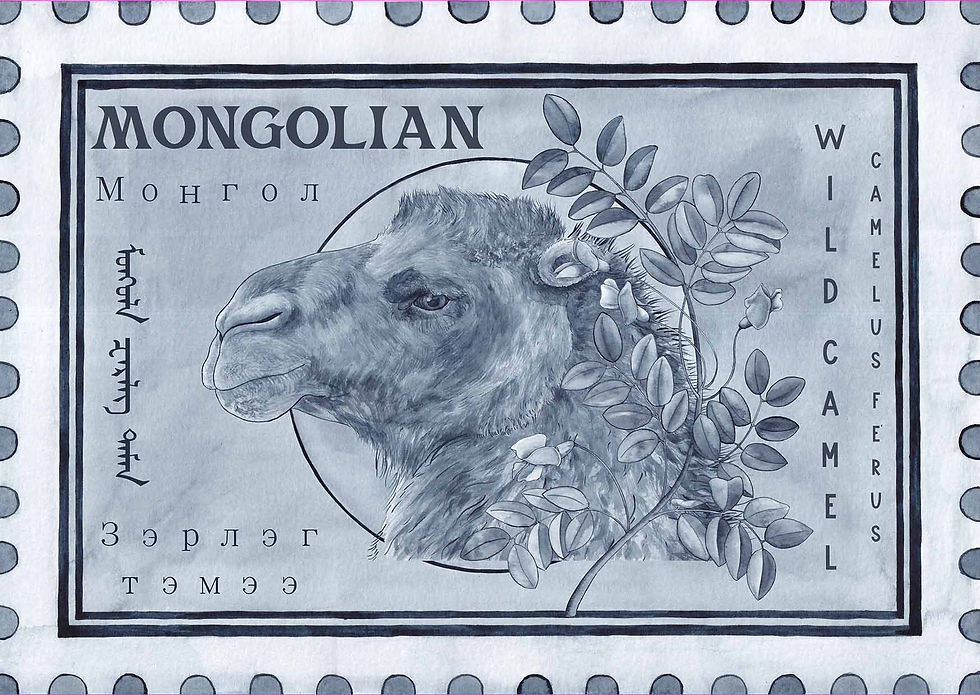
Colour experimentation followed. I initially based the palette closely on the vintage references, but test prints felt slightly off. After tweaking the tones, softening them into more muted pastels and removing a grain overlay the design became more cohesive and balanced. The final version feels calm, and harmonious.

I later added my signature in preparation for the exhibition. The artworks will be printed, framed by Kah-Wai Lin, and displayed at the Embassy in April. I’m incredibly excited to have a piece exhibited in the Mongolian Embassy and look forward to seeing how the event unfolds.
Final Prints:
A huge thank you to Pardicolour, the Wild Camel Protection Foundation, Kah-Wai Lin, and the Global Heritage Society for this opportunity!
References:


Comments